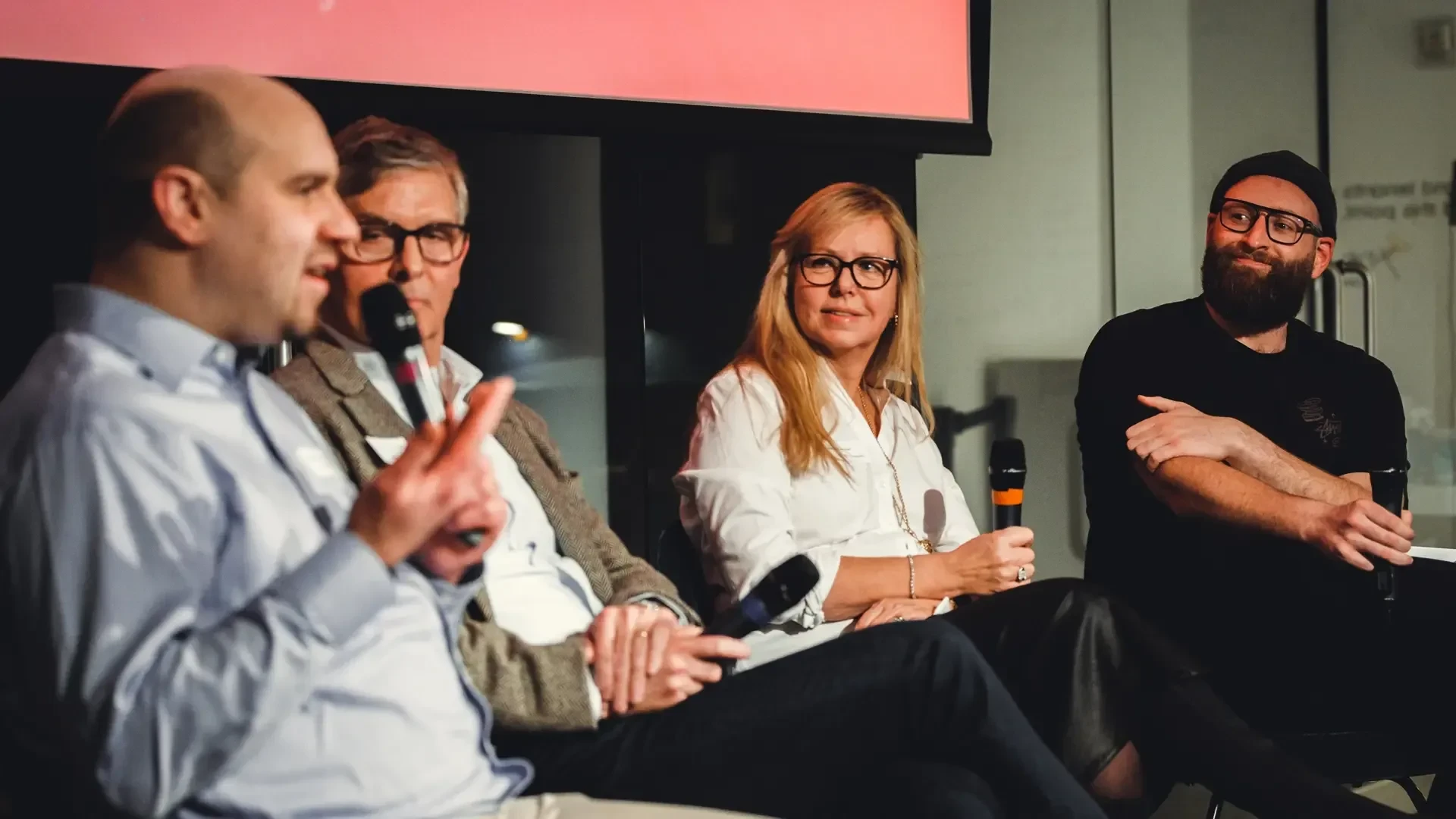
Three Connectd members, at very different points in their journeys, got honest about what the transition to advisory and fractional work actually looks like.
One evening in New York, a fractional CFO who had built a 1,000-person practice, a wellness founder who had walked away from L'Oreal, and two executives in the middle of the biggest career pivot of their lives, all sat in the same room. Outside, the city was still digging out from a blizzard. Inside, the conversation was about what it really takes to build a career in the fractional and advisory world.
The evening ranged wide. Sarah Lerche, a Connectd mentor with 16 years of fractional experience, delivered a keynote about building a fractional career from the ground up. Francia Cooper, founder of LEAP by FC, came at it from the other side of the table, having found advisory talent that transformed her startup. Sandwiched in the middle, was a panel session led by Connectd CEO & Founder Roei Samuel, where Sarah for the was joined by two Connectd members in the midst of career transition - John Hoeller and Eric Callahan - bringing a variety of perspectives on the journey to advisory success.
Here's what they covered on the night.
An open brief is an open door
Something most people don't expect when they make the move into fractional or advisory work: the founder often doesn't arrive with a fully formed brief. Often, there's no job description and no rigidly-defined scope meaning the engagement takes shape through conversation. While this ambiguity can be phasing, being able to shape the role from the bottom up can actually be one of the most rewarding aspects of advisory work.
Eric described his experience of that first founder meeting:
"You have your first meeting with your founder and they're kind of like: 'So what are you going to help me with?' And you're thinking: wait, I thought you were going to tell me that."
John's first placement followed a similar pattern. A London-based fashion brand wanted to explore opening a retail store in New York, and that brief only emerged after several conversations.
"I didn't know exactly what I was going to do, and I knew they weren't certain either. But having been in consulting for 40 years, I knew that if I asked the right questions, we'd figured it out from there."
What both of them discovered, and what Sarah has seen play out across hundreds of engagements, is that founders don't just want someone who can execute. They want someone who will really listen.
"You ask founders about their business. You listen to their problems. Then you explain how you might help. Sometimes they ask whether you've done something before. Even if you haven't done that exact thing, you say yes, because you know you can figure it out," said Sarah.
In fractional and advisory work, expertise is the entry point. What makes you successful is the ability to truly hear what is being said, stay responsive, and understand what a founder actually needs.
The mindset shift that changes everything
From service provider to peer
Skills, knowledge and experience get you to the table but what determines whether you stay - and whether a relationship grows from a provisional arrangement to a permanent paid position - is something different.
Roei put it plainly: "It's very tempting to lead with 'this is where I have value.' But fractional work asks you to flip it: where is your gap, and how can I plug it? The most effective people think entrepreneurially about their positioning, not just their expertise."
Sarah described the shift that she now helps the members she mentors work through:
"For a long time I had this mindset: I'm a service provider, therefore I serve my client. I had to get to: no, we're peers. It took me a couple of years of building the confidence to push back. It's something I see a lot of work through early on in their career transitions."
Being the trusted voice in the room
One of the most valuable things an advisor or fractional executive can offer a founder is the perspective they can't get from inside their own business. John found that his consulting background prepared him well for exactly that:
"I've had actual disagreements with CEOs. Real ones. And often they come back and say you were right. That's a big part of the job; you're the one who has the tough conversations, who asks the questions they haven't wanted to sit with."
Eric found that his data background gave him a lens that applied well beyond technical advice. The startup environment often demands immediacy, but Eric has built a habit of asking founders whether they would still be happy with a decision much further down the line:
"These are early-stage startups - they want to chase the shiny object. It's my job to say: 'If you make this change now, are you going to be happy that you did that in six months?' That turns out to be useful advice in a lt of areas of a business, not just data architecture."
Pro bono to paid: it's not a moment, it's a build
How the transition actually happens
One of the most energizing parts of the panel was hearing how naturally the path from exploratory engagement to paid work can unfold when approached with the right mindset. Eric currently works with two startups in the Connectd community, both in paid roles, one of which he converted from a pro bono placement. He reflected on the process:
"I don't know that there's a textbook way to convert a role to a paid position. You're having a conversation, building a relationship, staying engaged. 'Give me an idea' becomes 'give me a recommendation,' which becomes 'what's your rate?' I think I 'accidentally' sold my services by explaining what I know and what I can do!"
Staying in lockstep
What accelerates the transition, the panel agreed, is consistent presence. Not just showing up for scheduled calls, but walking alongside the founder between the formal meetings. Eric described one habit that had made a real difference:
"You send them a quick message once a week: 'I was thinking about this thing you mentioned.' And they think: this person is with me. You're not sacrificing everything for their startup, but you're engaged enough that they feel it."
For John, converting his placement was still in the pipeline, but he having laid the foundations, he is confident that will come. While the New York retail launch the model was built around is some way off, John had already named his day rate and set a calendar reminder for the right moment. He's building, not waiting.
Sarah's perspective on timelines was characteristically direct. One client came back to her seven years after their first conversation at a networking event. The seed had been planted, she had stayed in touch, and when the moment came, she was the obvious call.
"Plant a lot of seeds and nurture them. Some will come sooner, some later. Some you think have died will actually show up. That's not a bug in this model. That's how it works."
What they wish they'd known at the start
Roei closed the panel by asking each guest what they'd have told themselves at the start of their journeys. The answers were candid, and immediately recognizable to anyone who has made this kind of career move.
John offered that sitting with uncertainty is no bad thing:
"The ambiguity is okay. You'll find your place. I wish I'd given myself permission to believe that from day one."
Eric's focus was on playing a long game:
"It's not linear. The first year is really about foundations: learning, meeting people, building your network. Someone might call you back in seven years. That's not a slow start. That's exactly how this works."
Finally, Sarah reflected on the soft-skills and mentorship needed to succeed in a fractional career:
"I didn't realize how much of the job is teaching. I thought I was going to deliver metrics. Actually, I was building confidence in my CEOs, helping them understand their own business model, talk to investors, believe in what they were building. That turned out to be the most valuable thing I did."
Roei added a reflection from his own first advisory role, one that threaded back through everything the panel had covered:
"What they wanted, more than anything, was validation. They wanted to know they were on the right track. I initially got pulled into operations as that's where I thought that was my value was, but what they actually needed was a sounding board."
The real reward
What came through clearly, across every part of the conversation, was that the fractional and advisory world rewards people who show up with genuine curiosity and care. Expertise matters, but it's the relationships, the responsiveness, and the willingness to be truly present for the founders you work with that builds something lasting.
As AI takes on more execution-heavy work, the value of experienced human judgment, the kind that comes from decades of real decisions in real companies, is only growing. For professionals ready to bring that to the table in a new way, the opportunity is significant.
As Roei put it at the start of the evening:
"Don't wait until fractional work becomes a normal, mainstream career choice. Get ahead of it. Start building that track record, that visibility, that credibility, because it compounds."
The people who braved the sub-zero temperatures to be in that room already understood that. They weren't there for a shortcut. They were there to start building something for the long term.