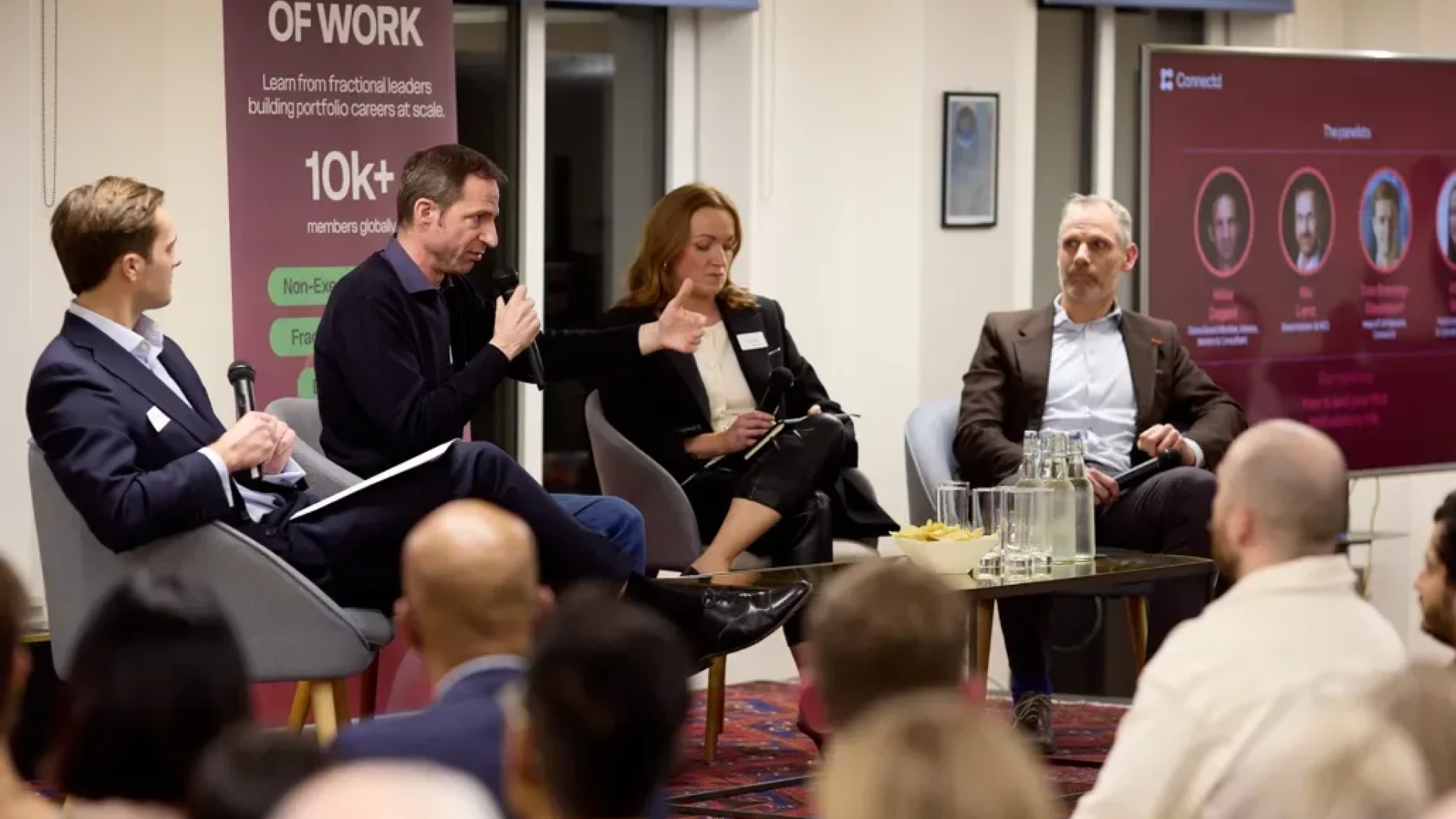
One of the most thought-provoking moments at Connectd's recent London panel came not in the form of advice, but a candid personal reflection.
Nic Lenz, a long-standing Connectd mentor and former investment banker, was refreshingly honest about something many in his position would quietly sidestep: how a large part of his credibility had always rested on the institutions behind him. "I went from Nic Lenz, investment banker, Morgan Stanley, UBS, Bank of America, to simply Nic Lenz," he said. "It's incredible how much of your credibility is tied up in those logos."
For the majority of people in the room, many just starting their transition from corporate roles, this felt like a familiar scenario. The conversation that followed covered everything from identity and positioning to mentoring, money matters, and how you know when your new career direction is really starting to work for you.
The identity shift no one prepares you for
The shift into fractional and advisory work is not just a change of structure or pace. It is a renegotiation of who you are and what you are worth when the corporate comfort blanket is removed. Truthfully, that is the part most career transition advice skims over.
Hidai Degani, who completed Connectd's Transition to Portfolio programme and has recently become a Connectd mentor, pushed back gently on the idea that the answer is to stay close to your existing sector. He now chairs an Academy board, in a field he has never worked in before. The thread connecting this role to his commercial career is not domain expertise, but rather the belief that most skills are transferable across sectors and stages. People often think they have to 'stay in their lane' but recent McKinsey research found workers who leverage transferable skills are 30% more likely to succeed in career pivots. "We all tend to downplay what we've done," he said. "Own your story, tell your story. You'd be surprised what comes back."
Nic made a similar point: when looking to fill advisory and board positions, board and advisory roles, founders don't always need someone from their own industry - they often want someone who will bring a fresh perspective, ask the right questions, challenge assumptions. That is a skill set that travels further than most people expect.
Finding your 'hook' in fractional and advisory work
The practical starting point, the panel agreed, is to find your hook: not a general offer of experience, but the one or two specific things you can bring that a founder will genuinely value. Nic spent a year meeting over 200 founders before he started his consultancy, not to pitch himself, but to understand what problems they were actually trying to solve. Two things came through consistently. Founders struggled with fundraising, and technically strong founders often lacked the commercial layer needed to translate an idea into a viable business. Those became his anchors, and everything else followed.
Mhairi Berry, who is on the Transition to Portfolio programme and has already moved into two paid fractional roles after a long senior career in global luxury brands such as Burberry, brought a different framing: compressed expertise. Stepping into an environment built around pace and agility rather than established process, she found that what founders value most is not always sector knowledge. It is the ability to bring structure, focus, and commercial rigour to a team that is moving fast. "What you know is the starting point," she said. "What you can actually do for them, right now, is what matters."
Why your mentor is your most underused asset
All three panellists spoke about the mentor relationship as something essential, particularly in the early stages of building an advisory portfolio. The consistent message was to invest time in finding the right fit: someone whose background and approach complement your own, and with whom you can be genuinely honest. "You are going to be in a relationship where vulnerability matters," Nic said. "That match is worth getting right."
Hidai, who has been on both sides of that relationship, was direct about how to make the most of it once you have it. "Prepare your mentor. Go through every small detail. The first meeting with a founder is the most nerve-racking part. Use us." The mentor has no agenda beyond your success and no emotional stake in the outcome. That kind of non-judgemental support, he suggested, is rarer than people realise, and worth leaning on fully.
Getting Paid in Advisory and Fractional Roles
Compensation in this space, particularly in early-stage advisory and board roles, often involves equity or a blended arrangement rather than a straightforward day rate, and going in with a realistic and open-minded view of what that looks like is part of doing the job well.
Nic's advice on earning the right to that conversation was straightforward: show a little latitude in time commitment - albeit carefully - from day one. Show up, do the pre-reading, think about their challenges between sessions. "Pay it forward. If you are good and adding value, the compensation will come."
The panel agreed that pro bono stage is not a compromise or concession. It is where you build the credibility and the relationship that makes the next steps in building a portfolio possible, and when the moment to discuss terms and remuneration arrives, it tends to feel like a natural next step.
Hidai's view was characteristically pragmatic: "Do whatever works for you. If you are enjoying it, being respected, and adding value, the possibilities are wide open."
How to know when the engagement is working
The question of fit ran through the whole evening. How do you know when a placement is right? The panel's answer was instinctive: you feel it after the call. If the founder's energy does not energise you back, if you are not thinking about their challenges between sessions, it may simply not be the right match. These setbacks are also great tools for learning - as Hidai put it: "There's no failure here. It's all experience."
Nic added a practical note on what happens when the engagement is working. Three of his five current board roles came through referrals from people he had worked with. "Once you get that flywheel going, you're off to the races," he said. "It's a small community. People talk to each other." The portfolio does not get built through a single well-timed decision. It gets built through consistent presence, genuine investment in the work, and the kind of relationships that come from showing up fully for the people you work with.
Want to find your own path to career change?
The journeys that Hidai and Mhairi have described, at different speeds and from different starting points, are exactly what Connectd's Transition to Portfolio programme is built around. Hidai completed the programme and now guides others along the same path as a mentor. Mhairi is two paid roles in and plans to expand her portfolio further. Nic, who has been a mentor on the Connectd platform since its early days, is a picture of what a portfolio career can look like further down the line, mixing advisory with non-exec and mentoring roles. Between them, they represent what the programme is designed to support: professionals who know what they are worth, know what they can offer, and have the community and support around them to forge their own particular path to success.
If you are ready to take your career in a new direction, find out more about how we could support you through the Transition to Portfolio programme here.