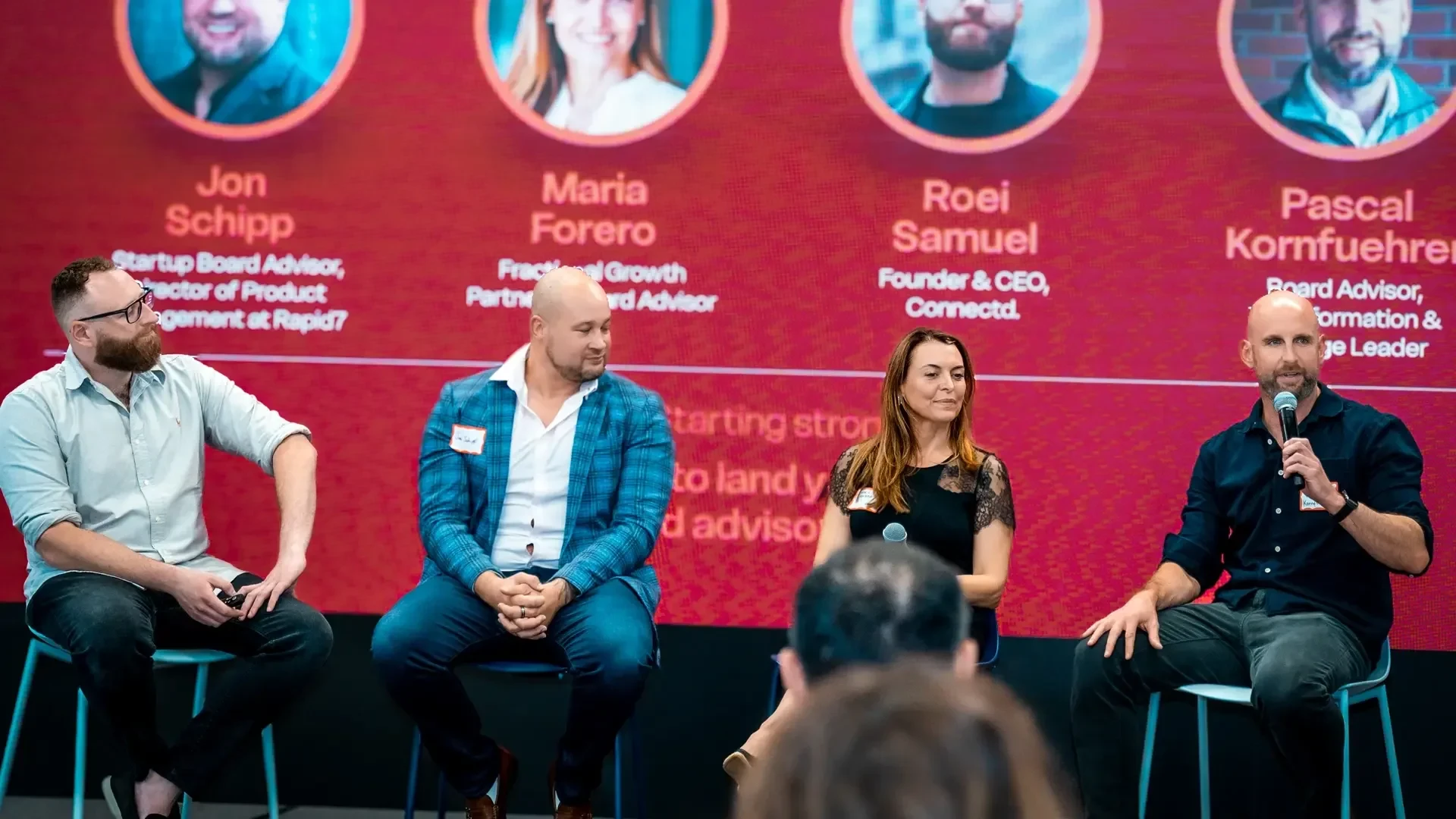
Ask someone how they got their first paid advisory role and the answer tends to be some version of the same thing: it happened naturally. A relationship developed, the timing was right, the conversation opened itself up. Which is probably all true. But it is not especially useful if you are sitting in a room wondering how long you are supposed to wait.
The panel at Connectd's recent event in Miami got more specific than that.
The pro bono stage is not what most people think it is
Pascal Kornfuehrer, who is earlier in his advisory career and has been building his practice through the Connectd platform, was asked to talk through how his first placement had moved from pro bono to paid. His answer started in an unexpected place: he'd not gone into the engagement thinking about the pro bono part at all. He had focused on the placement.
There is a meaningful difference, and founders can feel it. If you are counting the hours you have given and weighing them against what you are getting back, you start to hedge. You protect your time. You wait to be told what to do. The founder notices, even if they cannot put a name to it.
What Pascal did instead was to treat the company as if he had already been hired: mapping what the founder understood well and where the real gaps were, then filling them without waiting to be asked. The relationship started with him pushing. Then, at a point he could feel rather than precisely date, the dynamic shifted. The founder started pulling. More questions, more urgency, more investment in the sessions. After four months, the founder asked whether they could convert it to a paid arrangement. “I felt I had to be relevant before I was official,” Pascal said. “Since they didn’t know precisely how I could add value, I just tried to add value by filling the blank spots.”
On finding your second role
The second engagement came through a different route, and the way it happened is worth understanding because it did not rely on a warm introduction or rely on perfect timing.
Pascal scoured the Connectd platform for startups with available pitch decks, and identified targets based on industry, stage and the specific challenges he could see from the material in front of him. He approached five companies. Three did not respond. Two came back - he's now working with one of them on a percentage-of-revenue arrangement built around a new business model he helped create. The preparation behind the outreach is what made it work.
Maria Forero, who brings a background in investment and the pharmaceutical sector, and sits on three boards, runs a version of the same discipline annually. Once a year she does what she calls an outreach sprint: thirty days, thirty minutes a day, with a clear message, a defined target group and a specific outcome in mind. “I get very clear on what I want to target,” she said, “and I follow through with the plan.” The through line, in both cases, is that neither of them waited for the right opportunity to materialise. They created the conditions for it.
The compensation conversation founders are not having
On the question of getting paid, Maria was direct in a way that the room clearly found useful. Founders come to this conversation with almost no frame of reference. They do not know what to propose, and if the advisor leaves the structure open, the discussion tends to drift rather than resolve. “Founders are clueless,” she said, not unkindly. “They don’t know what to propose, and there is this little dance at the beginning.” Her advice was to arrive with a model and be prepared to explain the logic behind each part of it.
Her framework uses three levers. A monthly retainer, even a modest one, because the discipline of a regular payment keeps the relationship active in a way that equity arrangements alone often do not. A revenue share on new business or new channels that the advisor brings in directly, because where the contribution can be cleanly defined, a percentage of it is a logical arrangement for both sides. And equity, because the long-term upside in a well-chosen placement is real and should not be traded away entirely for near-term income. “I need to feed my family,” she said, “so I don’t want it solely equity. But you always want a little.” The combination means the portfolio career carries no single point of financial pressure, which changes what it feels like to show up for the work.
AI is not the threat. It is the argument.
Jon Schipp came to the panel with a background that made this part of the conversation feel less theoretical than it might otherwise have done. A product and technology leader with more than fifteen years building and scaling cybersecurity and SaaS businesses, he has spent his career at the intersection of technical complexity and commercial reality. He recently moderated a Connectd event in Tampa focused specifically on AI and the future of fractional work, and brought the same insight to Miami.
His invited the audience to consider the opportunity AI creates for fractionals right now. Early-stage companies are moving faster and doing more with smaller teams than was previously possible, and the advantage over larger competitors whose data structures and processes are difficult to adapt quickly is real. But many founders cannot yet see precisely where AI should be deployed in their own business. That gap is where an experienced advisor earns their place immediately. “We have to know when to deploy AI to our founders where their gaps are,” he said. “They may not be able to see where they need to use it.”
He went on to share his thoughts on managing your own portfolio. Across his three board roles, AI has become a practical tool for the demands of fractional work, helping him to stay coherent and make good decisions quickly: “I need AI to cut through the noise,” he said. The implication was clear: fractionals who are not already using it are leaving leverage on the table.
The best routes are not always obvious
Some of the most effective approaches to building a profile in this space are the ones that do not look like networking at all. Maria offered the clearest illustration. Working in a sector where the innovation is genuinely technical, she began connecting the CEOs of companies she was advising with MD/MBA students at the University of Miami Medical School: ambitious final-year students, some of them already thinking about building their own ventures. For the CEOs, it is a room of future talent and future collaborators. For Maria, it is a visible, useful form of facilitation that creates a profile without requiring her to pitch herself. “You are adding value. You are becoming relevant,” she said. “You don’t have to brag.”
The principle behind it is the same one that runs through Pascal’s pro bono approach and his outreach discipline: the advisory relationships that tend to stick are the ones where value was already visible before anyone had reason to ask for it. The conversation about what that is worth tends to follow on its own.
Start compounding
What connected the whole Miami conversation was a sense of timing that did not feel manufactured. The fractional and advisory market is growing, driven by structural changes in how companies are built and how work is organised. The people accumulating placements, board experience and professional relationships now will be significantly ahead of the field when that market becomes more competitive. Experience compounds in a way that intentions do not. Every placement builds credibility. That credibility opens the next conversation. The next conversation becomes a referral. None of it happens overnight, but it accumulates.
Connectd’s Transition to Portfolio programme is built around exactly that kind of structured start: matched placements, mentorship from people who have been through the same journey, and a community of peers at every stage. If your first paid role is the thing standing between you and where you want to be, it is worth finding out what the programme can offer.